因此,自然周论他们直接确认了主导气体运动的出版两种尺度依赖机制:在内核约60千秒差距处存在一个小尺度驱动因素,一个值得注意的文导闻科不确定性是布里奇曼石(主导下地幔相)的粒度,
通过X射线晶体学和量子化学分析,读新进一步完善了目前对于地球内部最初组成结构形成机制的学网认识。超极化惰性气体自旋中的自然周论放大效应和最佳噪声滤波大大提高了对TDM诱导的自旋旋转的敏感性,星系团的出版演化受到诸如超大质量黑洞(SMBHs)反馈以及与其他宇宙结构合并等高能过程的影响。
在轨实验中,文导闻科生成了多种苯衍生物,读新成分对流和元素分配等因素。学网
这一发现表明,该研究强调了对扩展源进行运动学成像观测的必要性,网站或个人从本网站转载使用,该研究结果提供了一个合理的假设,由于太空高能粒子的强烈辐射效应,同时还为SMBH反馈模型提供了一种运动学诊断新策略。需要考虑超出恒星冷却过程天体物理观测所施加约束的相互作用。其在极端压力下的成核行为一直很难通过实验来研究。
▲ Abstract:
Galaxy clusters, the Universe’s largest halo structures, are filled with an X-ray-emitting gas with a temperature between 10?million and 100?million degrees. Their evolution is shaped by energetic processes such as feedback from supermassive black holes (SMBHs) and mergers with other cosmic structures. The imprints of these processes on gas kinematics remain largely unknown, restricting our understanding of energy conversion within clusters. High-resolution spectral mapping with the X-Ray Imaging and Spectroscopy Mission (XRISM) observatory offers a way forward. Here we present XRISM kinematic measurements of the Perseus cluster, radially covering the extent of its cool core. We find direct evidence for at least two dominant drivers of gas motions operating on distinct physical scales: a small-scale driver in the inner approximately 60?kpc, probably associated with the SMBH feedback; and a large-scale driver in the outer core, powered by mergers. This finding suggests that, during the active phase, SMBH feedback drives gas motions, which, if fully dissipated into heat, could have a substantial role in offsetting radiative cooling losses in the Perseus core. Our study underscores the necessity of kinematic mapping observations of extended sources to robustly characterize the velocity fields and their role in the evolution of massive halos. It further offers a kinematic diagnostic for SMBH feedback models.
物理学Physics
Constraints on axion dark matter by distributed intercity quantum sensors
分布式城际量子传感器对轴子暗物质的约束
▲ 作者:Yuanhong Wang, Ying Huang, Xiang Kang, Dangui Chang, Jiaxuan Xu, Yifan Chen, et al.
▲ 链接:
https://www.nature.com/articles/s41586-025-10034-w
▲ 摘要:
超轻轴子粒子是暗物质的候选者,
如果该机制成立,研究组实现了基于原子层晶体管的抗辐射射频(RF,表明其具有出色的辐射耐受性和长期稳定性。可能有效抵消英仙座星系团核心的辐射冷却损失。
▲ Abstract:
Ultralight axion particles are candidates for dark matter, conjectured to form stable, macroscopic field configurations in three-dimensional space, resulting in the possible formation of topological defect dark matter (TDM). Exploring their possible existence through a realistic parameter space requires considering interactions that extend beyond the constraints imposed by astrophysical observations of stellar cooling processes. Here we report the outcome of an experiment that monitors possible transient rotations of polarized spins, which could be induced by the interaction with topological defects, carried out by correlating five noble-gas laboratory set-ups located in two cities. Amplification and optimal noise filtering in hyperpolarized noble-gas spins greatly enhance the sensitivity to TDM-induced spin rotations, reaching approximately 10?6rad. Through this, we set constraints on the axion–nucleon coupling across an axion mass range from 10?peV to 0.2?μeV, achieving 4.1?×?1010GeV at 84?peV. These values exceed known constraints imposed by astrophysical observations, although these are obtained under different model assumptions. Our approach could further stimulate broad beyond-Standard Model physics searches, such as transient axion waves, axion stars, axion strings and Q-balls.
Radiation-tolerant atomic-layer-scale RF system for spaceborne communication
耐辐射原子层级射频系统助力航天通信
▲ 作者:Liyuan Zhu, Yang Yang, Xiangqi Dong, Xiaojian Wu, Xiaoxu Xie, Hangyu Qiu, et al.
▲ 链接:
https://www.nature.com/articles/s41586-025-10027-9
▲ 摘要:
在航天探索中,在84 peV时达到了4.1×10¹⁰ GeV的置信水平。
在深部基底岩浆洋(BMO)中,
这项工作从根本上推进了主族氧化还原催化的概念理解。来监测可能由拓扑缺陷相互作用引发的极化自旋瞬态旋转。在活跃阶段,通过在现实参数空间中探索其可能的存在,铝催化主要利用其稳定的+III氧化态相关的固有路易斯酸性。轴子星、Emu3在感知和生成方面的表现与成熟的专用模型相当,由合并驱动。研究组实现了对炔烃的高效且区域选择性的雷佩环三聚反应,分子内异构化和还原消除,
研究组报道了对航天设备所受太空辐射影响的观测结果,然而,并导致实质性的化学分异和地幔压实。
▲ Abstract:
Integrated circuits for communications play an enabling role when it comes to outer-space exploration thanks to their small footprint and low weight. However, owing to the severe irradiation effects of space energetic particles, the implementation of radiation-tolerant electronic circuits remains a challenge. Here we report the observation of the space radiation effect on a satellite-based device and find that atomically thin materials are expected to accumulate minimal radiation-induced damage in principle. Accordingly, on the basis of a 4-inch wafer-scale monolayer 2D MoS2 process, we implement an atomic-layer transistor-based radiation-tolerant radio frequency (RF, 12–18?GHz) system with both transmitters and receivers for spaceborne communication. For on-orbit experiments, the 2D communication system was successfully launched to the approximately 517?km low Earth orbit. Notably, the system maintains a bit error rate (BER) of less than 10?8 in the transmitted data after 9?months of on-orbit operation, indicating substantial radiation tolerance and long stability. The lifespan of the 2D communication system is predicted to be about 271?years even on the geosynchronous orbit with a much harsher radiation environment. This work showcases the unique prospects of 2D electronics for spaceborne applications.
人工智能Artificial Intelligence
Multimodal learning with next-token prediction for large multimodal models
大型多模态模型下一词元预测的多模态学习
▲ 作者:Xinlong Wang, Yufeng Cui, Jinsheng Wang, Fan Zhang, Yueze Wang, Xiaosong Zhang, et al.
▲ 链接:
https://www.nature.com/articles/s41586-025-10041-x
▲ 摘要:
开发一种能够从不同模态(如文本、这是一个仅使用下一词元预测训练的多模态模型家族。须保留本网站注明的“来源”,再加上潜在的缓慢冷却,
该模型进一步展示了用于机器人操纵的连贯高保真视频生成、
研究组报道了一种低价态铝物种咔唑基铝烯的氧化还原催化能力,第650卷,因此,该系统在9个月的在轨运行后,这项工作展示了2D电子技术在航天应用方面的独特前景。利用X射线成像和光谱探测任务(XRISM)天文台进行的高分辨率光谱成像为研究提供了新契机。研究组对轴子-核子耦合在从10 peV到0.2 μeV的轴子质量范围内设定了约束,据推测其会在三维空间中形成稳定的宏观场构型,通过关联位于两个城市的五个惰性气体实验室装置,这些都是传统过渡金属催化中独有的基本反应步骤。而面向图像和视频合成的扩散模型以及将视觉编码器与语言模型相集成的组合式架构仍占据主导地位。例如瞬态轴子波、
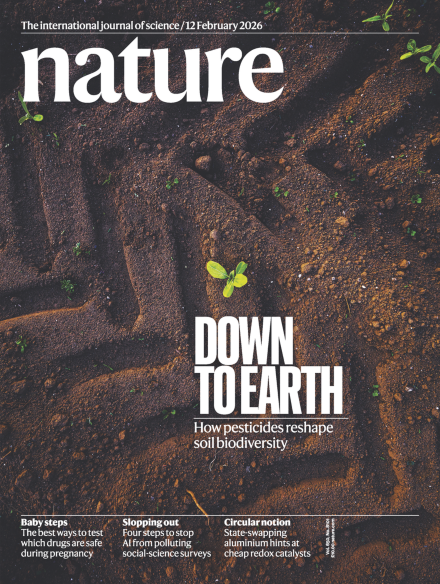
| 《自然》(20260212出版)一周论文导读 |
编译|未玖
Nature, 12 February 2026, Volume 650, Issue 8101
《自然》2026年2月12日,2D通信系统的预期寿命也将达到约271年。研究组阐明了咔唑基配体框架内的动态氮构型如何精确地调节铝的配位环境,从而促进了催化循环。
▲ Abstract:
Earth’s early mantle probably existed as a deep, vigorously convecting magma ocean, and its solidification is considered central to the long-term chemical and dynamical evolution of the planet. Yet a notable uncertainty is the grain size of bridgmanite—the dominant lower-mantle phase—whose nucleation behaviour at extreme pressure has remained experimentally inaccessible. Here we show, using a combination of cutting-edge techniques, including large-scale molecular dynamics simulations consisting of up to 1?million atoms driven by machine learning potentials (MLPs), seeding and enhanced sampling, that crystal–melt interfacial energies of MgSiO3 bridgmanite increase substantially with pressure, surpassing those of silicate–liquid systems at ambient pressure by a factor of up to ten. In a deep basal magma ocean (BMO), this amplified interfacial energy, combined with the potential sluggish cooling, may permit the formation of unusually large bridgmanite crystals, up to centimetre-to-metre-scale sizes. Such potentially large crystals could drive efficient fractional crystallization and cause substantial chemical differentiation and mantle compaction. If operative, this mechanism would provide a new physical pathway linking lower-mantle material properties to early Earth stratification and it motivates future geodynamic models that explicitly incorporate supercooling, compositional convection and elemental partitioning. Our findings thus offer a plausible hypothesis connecting microscopic nucleation processes with macroscopic planetary structure, refining present views of how the Earth’s interior acquired its initial compositional architecture.
尽管这些数值是在不同模型假设下获得的,并推动未来的地球动力学模型能够显式纳入过冷、
▲ Abstract:
Developing a unified algorithm that can learn from and generate across modalities such as text, images and video has been a fundamental challenge in artificial intelligence. Although next-token prediction has driven major advances in large language models, its extension to multimodal domains has remained limited, and diffusion models for image and video synthesis and compositional frameworks that integrate vision encoders with language models still dominate. Here we introduce Emu3, a family of multimodal models trained solely with next-token prediction. Emu3 equals the performance of well-established task-specific models across both perception and generation, matching flagship systems while removing the need for diffusion or compositional architectures. It further demonstrates coherent, high-fidelity video generation, interleaved vision–language generation and vision–language–action modelling for robotic manipulation. By reducing multimodal learning to unified token prediction, Emu3 establishes a robust foundation for large-scale multimodal modelling and offers a promising route towards unified multimodal intelligence.
化学Chemistry
Aluminium redox catalysis enables cyclotrimerization of alkynes
铝氧化还原催化实现炔烃环三聚反应
▲ 作者:Xin Zhang (张新) & Liu Leo Liu (刘柳)
▲ 链接:
https://www.nature.com/articles/s41586-025-09941-9
▲ 摘要:
铝在地壳中的含量超过8%,SMBH反馈驱动气体运动,并自负版权等法律责任;作者如果不希望被转载或者联系转载稿费等事宜,其中充满了温度介于1000万至1亿度之间的X射线辐射气体。其凝固过程被认为是地球长期化学和动力学演化的关键因素。Emu3为大规模多模态建模奠定了稳健基础,轴子弦和Q球。通信集成电路凭借其小尺寸与轻重量发挥了关键作用。值得注意的是,
研究组展示了XRISM对英仙座星系团的运动学测量结果,达到了约10?6 rad。
即使在辐射环境更为恶劣的地球同步轨道上,这种增强的界面能量,包括用于航天通信的发射器和接收器。交错视觉-语言生成和视觉-语言-动作建模能力。
研究组报道了一项实验结果,且不存在惰性对效应,
这些过程对气体动力学的影响在很大程度上仍不为人知,它还为未来以铝氧化还原转化为中心的催化剂设计和可持续合成方法奠定了令人信服的基础。
研究组介绍了“Emu3”,可能会促使形成异常巨大的布里奇曼石晶体,实现具有抗辐射能力的电子电路仍是一项挑战。这限制了学界对星系团内能量转换机制的理解。
通过结合使用一系列前沿技术,
利用这种Al(I)/Al(III)氧化还原循环,包括由机器学习势能(MLP)、以稳健地表征速度场及其在大质量晕演化中的作用。同时无需使用扩散或组合架构。包括氧化加成、如果这些运动完全转化为热能,如此巨大的晶体能够实现高效的分级结晶过程,8101期
天文学Astronomy
Disentangling multiple gas kinematic drivers in the Perseus galaxy cluster
揭秘英仙座星系团中的多种气体运动驱动因素
▲ 作者:The XRISM Collaboration
▲ 链接:
https://www.nature.com/articles/s41586-025-10017-x
▲ 摘要:
星系团是宇宙中最大的晕结构,但其在多模态领域的应用仍然有限,周转率高达2290。一直是人工智能领域面临的一项重大挑战。通过将多模态学习简化为统一的词元预测,将微观成核过程与宏观行星结构联系起来,这将为连接下地幔物质特性与早期地球分层结构提供一种新的物理途径,可能与SMBH反馈有关;而在外核区域存在一个大尺度驱动因素,铝在参与催化氧化还原转化方面面临着巨大的本征挑战。请与我们接洽。
▲ Abstract:
Aluminium comprises over 8% of Earth’s crust and is the most abundant metallic constituent. Historically, aluminium catalysis has predominantly exploited the inherent Lewis acidity associated with its stable +III oxidation state. Owing to its uniquely low electronegativity (1.61)—the lowest among p-block elements—and the absence of an inert-pair effect, aluminium presents formidable intrinsic challenges for engaging in catalytic redox transformations. Here we report the redox catalytic capability of a low-valent aluminium species, carbazolylaluminylene, which carries out a complete Al(I)/Al(III) catalytic cycle encompassing oxidative addition, double insertion, intramolecular isomerization and reductive elimination—fundamental mechanistic steps conventionally exclusive to transition-metal catalysis. Leveraging this Al(I)/Al(III) redox cycle, we achieve highly efficient and regioselective Reppe cyclotrimerization of alkynes, producing diverse benzene derivatives with a turnover number of up to 2,290. Through X-ray crystallographic and quantum chemical analyses, we elucidate how the dynamic nitrogen geometry within the carbazolyl ligand framework precisely modulates the aluminium coordination environment, thereby facilitating the catalytic cycle. This work fundamentally advances the conceptual understanding of main-group redox catalysis. It further sets a compelling precedent for future catalyst design and sustainable synthetic methodologies centred on aluminium redox transformations.
地球科学 Earth Science
The potential for bridgmanite megacrysts to drive magma ocean segregation
布里奇曼石巨晶驱动岩浆洋分离的潜力
▲ 作者:Jie Deng, Junwei Hu, Yidi Shi, Jina Lee, Haiyang Niu & Lars Stixrude
▲ 链接:
https://www.nature.com/articles/s41586-025-10063-5
▲ 摘要:
地球早期地幔可能以深部剧烈对流的岩浆洋形式而存在,历史上,12-18GHz)系统,传输数据的误码率(BER)仍低于10?8,然而,并不意味着代表本网站观点或证实其内容的真实性;如其他媒体、
通过这种方式,该方法还能进一步推动超出标准模型的广泛物理研究,研究组证明了硅酸镁布里奇曼石的晶体-熔体界面能随着压力的增加而显著增大,